Not 300 vulnerabilities – just the three that matter today.
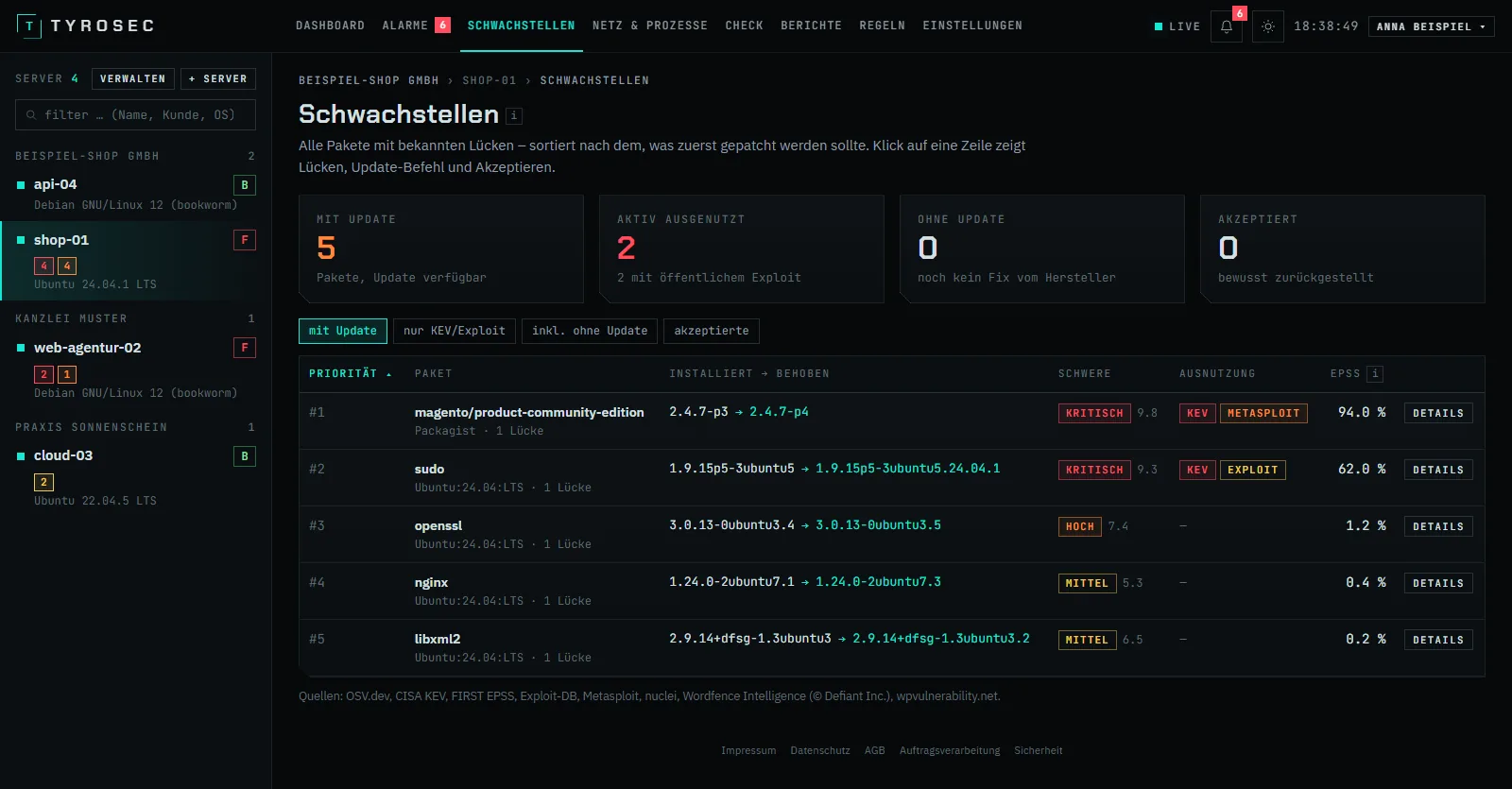
tyrosec inventories all installed packages and libraries, continuously matches them against security advisories and sorts them by what attackers actually exploit. With the right update command included.
Vulnerability scanners produce lists, not decisions.
An average web server has dozens of known vulnerabilities – in the kernel, in OpenSSL, in a WordPress plugin, in an npm library deep in the project. A traditional scanner delivers a list of hundreds of CVE numbers and CVSS scores, most of which are never exploited in practice.
Admins have to guess where to start. In the end, the list gets ignored – and the one vulnerability being actively exploited right now stays open.
Prioritized by real risk, with a fix.
tyrosec determines the installed packages of the operating system and applications – in containers, too – and matches them hourly against distribution security advisories and the OSV database. Backported security fixes from Debian and Ubuntu are handled correctly, so no phantom vulnerabilities appear.
Everything is sorted by urgency: Is the vulnerability actively exploited according to CISA KEV? How likely is exploitation according to EPSS? Is there a public exploit? For each vulnerability, tyrosec shows the fixed version and the update command. Risks you consciously accept can be marked with a justification.
What gets checked
- Operating system packagesDebian, Ubuntu, Red Hat Enterprise Linux, AlmaLinux, Rocky Linux, CentOS Stream, Oracle Linux, CloudLinux, openSUSE, SLES and Alpine. Systems without security updates (e.g. CentOS 7, Debian 10) are flagged with their end-of-support date.
- WordPressCore, plugins and themes of every detected installation, with a note when newer versions exist. Plugins removed from the WordPress.org directory are reported with high severity – with the reason, if WordPress.org gives one.
- Composer and npmDependencies from
composer.lockandpackage-lock.jsonin all webroots. For Composer, also as a note: packages with a newer stable version and packages abandoned by their authors. - Shop plugins and modulesMagento modules in
app/code, Shopware plugins incustom/pluginsand PrestaShop modules are inventoried with version and checked – PrestaShop modules via the Friends-of-Presta security advisories, the others via Packagist and OSV where a Composer name is known. - ContainersPackages in nspawn, Docker, Podman and LXC containers, listed separately per container.
- Resolved automaticallyAfter an update, the vulnerability disappears from the list on its own – no click needed.
- Security score A–FVulnerabilities, hardening and open findings combine into an easy-to-understand security score per server.
- Only what is actually runningKernel vulnerabilities count for the running kernel – not for one installed but not yet booted, and never for kernel headers inside containers.
- One alert per packageAll vulnerabilities of a package in one message, ordered by exploitation – containers with a hint to rebuild from a fresh base image.
End of support in view
Without security updates, even the best patch management is no help. tyrosec warns in good time when the operating system of a server – or of a container on it – reaches the end of its support, with the date and the advice to plan the upgrade. If Ubuntu Pro (ESM) is active, tyrosec recognises it from the installed packages: instead of an alarm you get a calm notice of how long the extended security updates will run.
The same applies to applications and PHP: for detected apps such as WordPress, Magento, Shopware, TYPO3, Laravel, Drupal or Nextcloud and for the PHP version, tyrosec shows the support status according to endoflife.date and reports a reached end of support just like for the operating system.
Vulnerability management FAQ
How up to date is the data?
Matching runs hourly. The agent reports new packages on the server with every inventory; security advisories and the KEV list are updated continuously.
What do KEV and EPSS mean?
KEV is the list maintained by the US agency CISA of vulnerabilities that are known to be actively exploited. EPSS estimates the probability that a vulnerability will be exploited in the next 30 days. Together, they are a far better measure than the CVSS score alone.
Does tyrosec install updates itself?
No. tyrosec shows the right command; you apply the update deliberately. That way you stay in control of reboots and maintenance windows.
More features
See what’s happening on your server in two minutes.
Install the agent with a one-liner, wait for the initial scan, done. 14 days free, up to 3 servers, no credit card required.